
Статия: 9 Custom Wedding Band Examples to Make Your Own
9 Custom Wedding Band Examples to Make Your Own
A wedding band is worn through ordinary Tuesdays as much as milestone celebrations. That is why the most compelling custom wedding band examples are not simply decorative. They hold a private reference, suit the wearer’s hand and lifestyle, and feel as considered ten years from now as they do on the day itself.
A bespoke band can be quietly classic or distinctly sculptural. The right direction depends on the jewellery you already wear, the profile of an engagement ring if there is one, and how much of your story you want the design to reveal. These ideas offer a refined starting point for creating a ring with true personal presence.
Custom wedding band examples for every style
1. A hand-engraved gold band
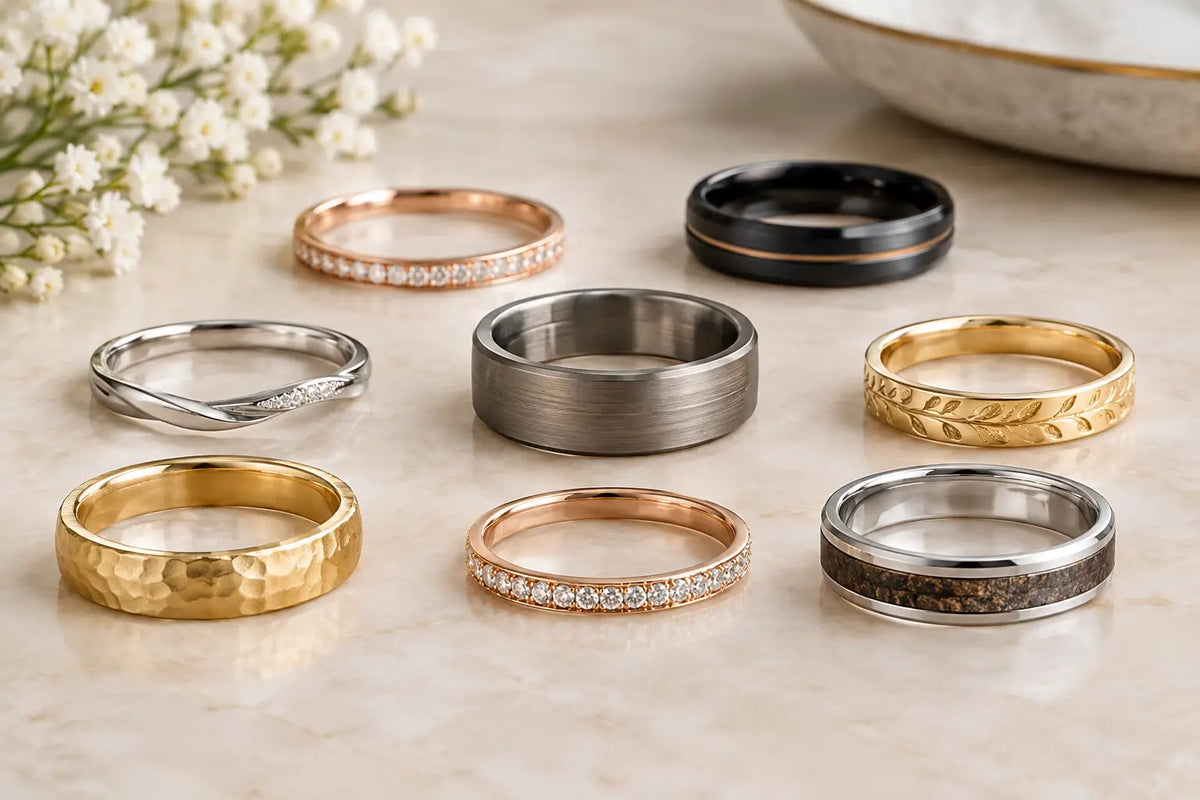
An engraved band brings detail to an otherwise clean silhouette. Fine scrollwork, botanical motifs, Art Deco geometry or a pattern inspired by lace can be cut across the surface of a 9ct or 18ct gold ring. The result has depth without relying on diamonds, making it an elegant choice for someone drawn to antique-inspired jewellery.
A full engraving makes a confident statement, while a motif placed only at the centre offers a more understated finish. Consider how the engraving will wear over time: deeper, hand-finished detail is especially rewarding for a ring intended to become a future heirloom.
2. A flush-set diamond eternity band
For understated brilliance, small diamonds set flush into a polished precious-metal band create light without a raised setting. This style is beautifully practical for daily wear, as the stones sit level with the surface and are less likely to catch on knitwear or gloves.
Diamonds may be arranged in a single central line, scattered organically or placed at meaningful intervals. A sequence of stones can mark a date, a shared number or the month of a wedding. Platinum lends the design a cool, enduring character, while yellow gold creates a warmer, more traditional expression.
3. A contoured band designed around an engagement ring
Not every engagement ring sits neatly beside a straight band. A contoured wedding ring is shaped to follow the curve of a centre stone, setting or shoulder detail, creating a close and intentional fit. It can be gently dipped, deeply curved or shaped with a subtle point, depending on the engagement ring’s architecture.
The aim is not necessarily to make both rings disappear into one. A fine negative space between them can look equally considered. Seeing the two pieces together during the design process helps establish the right balance of height, width and curve.
4. A mixed-metal wedding band
Mixed metal offers a polished way to honour different preferences within one piece. A yellow gold exterior with a white gold or platinum inner band feels classic from afar, then reveals an unexpected detail to its wearer. Alternatively, a rose gold edge can soften a platinum centre, giving a contemporary ring warmth and contrast.
This approach also works particularly well for couples who favour different metals in their existing jewellery. Rather than choosing one over the other, a bespoke design allows both to become part of the story. Keep the proportions deliberate: a fine contrasting inlay feels discreet, while equal-width sections have a bolder, graphic effect.
5. A fingerprint or handwriting band
The most personal custom wedding band examples often hold a detail no one else would recognise at first glance. A fingerprint impression, a short handwritten phrase or the trace of a signature can be engraved inside the ring. It preserves intimacy while allowing the exterior to remain classically refined.
Because the available space is limited, short words and simple scripts tend to reproduce most clearly. A private nickname, initials, a date or a few words from a note can be enough. This is a design where restraint makes the sentiment feel stronger.
6. A textured band with an organic finish
A hand-hammered, brushed or softly irregular surface gives precious metal a tactile quality that high-polish bands do not offer. The finish catches light in a gentler, more changeable way, making every movement feel considered. It suits those who prefer jewellery with an artisanal, less formal character.
Texture can cover the entire ring or frame a polished central section. A brushed finish is beautifully modern, while a hammered surface has a more expressive, handcrafted quality. Bear in mind that some finishes evolve with wear, acquiring a soft patina that becomes part of the band’s character.
7. A signet-inspired wedding ring
A signet-inspired band is a strong choice for anyone who wants a wedding ring with substance and presence. The top can be lightly flattened or shaped into a low oval, then left beautifully plain, engraved with initials or set with a single diamond. It feels equally at home in a minimalist wardrobe or alongside more traditional fine jewellery.
The key is proportion. A slightly wider band with softened edges can feel substantial without being heavy, while a slimmer profile gives the signet concept a more discreet interpretation. This style is especially effective when made in rich yellow gold, though platinum offers a strikingly modern alternative.
8. A coloured gemstone detail
Diamonds are timeless, but a fine coloured gemstone can bring an unexpected note of personality. A deep blue sapphire, vivid green emerald or soft pink tourmaline can be set as a single accent, a delicate channel or a hidden stone on the inside of the band.
A concealed gemstone is ideal for couples who want colour with a private meaning. A visible row creates more of a signature look, though it requires careful consideration of wear and setting style. Gemstone choice should be guided by more than colour alone: hardness, cut and the protection offered by the setting all matter for a ring worn every day.
9. Two bands with a shared design code
Matching wedding bands do not need to be identical. A more sophisticated approach is to create two rings that share one connecting element: the same engraving, a matching interior metal, a repeat of the same edge detail or an identical hidden diamond. Each band can then be tailored to its wearer’s preferred width, finish and metal.
This works particularly well where one person wants a classic plain band and the other prefers diamonds or a sculpted profile. The relationship between the rings remains clear, but neither design feels like a compromise. It is a thoughtful expression of partnership that honours individuality.
How to turn inspiration into a lasting design
The strongest bespoke rings begin with practical decisions as well as visual references. Start by considering width and profile. A slimmer band may feel elegant and light, while a broader band gives engravings, textures and stones more room to breathe. Rounded edges offer a comfortable fit, particularly for those unused to wearing rings, while a flat profile makes a sharper modern statement.
Metal should be chosen with daily life in mind. Platinum is valued for its naturally white appearance and reassuring weight. Gold offers a spectrum of character, from the richness of yellow gold to the soft romance of rose gold and the cool restraint of white gold. If your engagement ring is already part of the equation, matching its metal can create continuity, but contrast can be equally beautiful when it is intentional.
Finally, allow space for the detail that makes the band yours. It may be an engraving only you will see, a stone that reflects a meaningful place, or a silhouette shaped around a much-loved engagement ring. Through Harper Kendall’s bespoke jewellery service, this conversation can become a considered design rather than a choice from a display.
The best wedding band does not need to announce its meaning to anyone else. It simply needs to feel right on your hand, every time you look down.

